
Janaka Liyanarachchi
Health sector experts have raised concerns that, for the first time in Sri Lanka’s history, there is a serious risk of medical graduates becoming unemployed in the coming years.
According to expert sources, this crisis is likely to arise due to the production of medical graduates far exceeding the number of vacancies approved by the Ministry of Health, coupled with the failure to conduct an updated cadre revision to determine the actual number of doctors required by the country’s healthcare system.
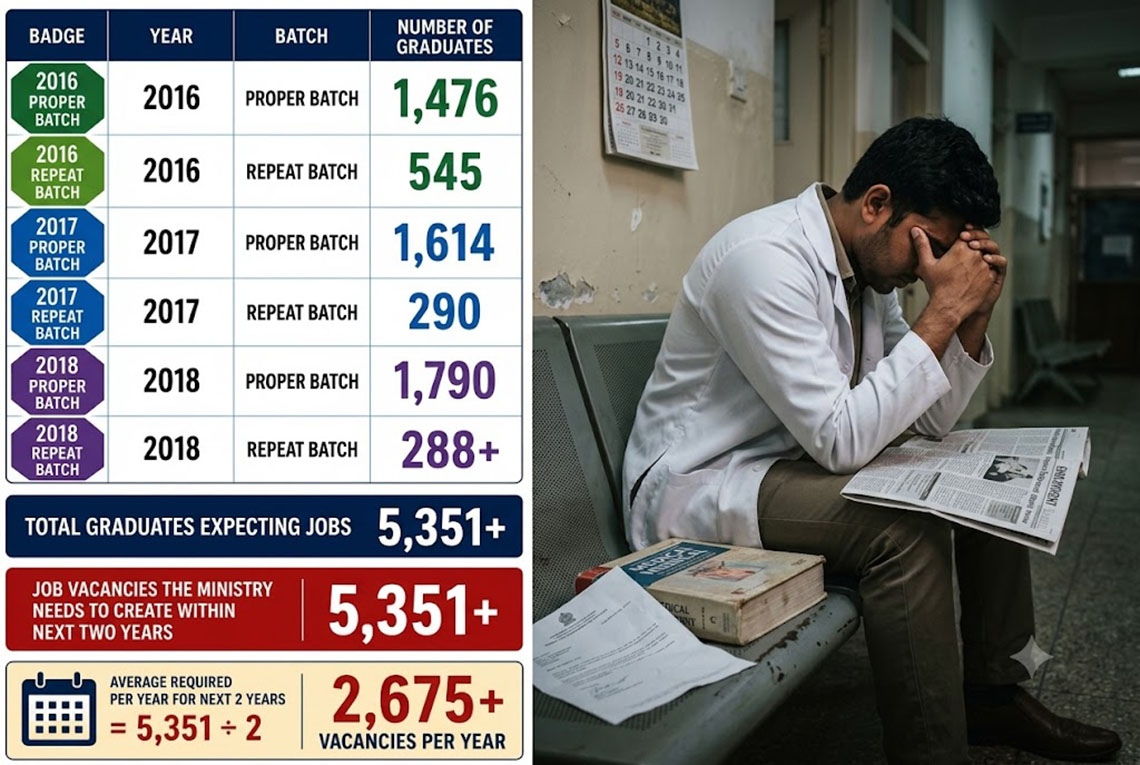
Medical Graduates Expected Over the Next Two Years
Official data indicate that the following numbers of medical graduates are expected to enter the job market within the next two years:
- 2016 Proper Batch – 1,476 graduates
- 2016 Repeat Batch – 545 graduates
- 2017 Proper Batch – 1,614 graduates
- 2017 Repeat Batch – 290 graduates
- 2018 Proper Batch – 1,790 graduates
- 2018 Repeat Batch – More than 288 graduates
This brings the total number of medical graduates seeking employment to more than 5,351.
To absorb these graduates into the public health sector, the Ministry of Health would need to create over 5,351 new positions within the next two years. This would require the recruitment of approximately 2,675 doctors annually during that period.
Causes of the Emerging Crisis
Experts point out that the current healthcare system can only accommodate a limited number of new doctors through vacancies created by retirements and migration.
Although the government’s “AROGYA” programme is expected to create around 1,000 new positions, experts warn that this will still be insufficient to meet the projected demand.
They further note that no comprehensive cadre revision has been conducted to justify these recruitments, nor have the necessary approvals been obtained from the Treasury and the Department of Management Services.
As a result, experts caution that unless urgent action is taken, the country’s medical employment sector could reach saturation by 2032, making it increasingly difficult for newly qualified doctors to secure employment.
Proposed Solutions
To address the looming employment crisis, health sector experts have proposed four immediate measures:
- Limit student intake to local medical faculties.
- Temporarily suspend the establishment of new medical faculties.
- Halt the referral of local students to foreign medical universities for medical education.
- Reduce overtime and extra-duty payments while introducing a shift-based recruitment system.
Foreign Medical Graduates
At present, nearly 300 doctors who obtained medical degrees from foreign universities have joined Sri Lanka’s health service. These graduates have traditionally been recruited into the Government Medical Service after passing the Act 16 examination.
Experts note that the current minimum qualification required for students to pursue medical education abroad is two B passes in Biology-related subjects and one simple pass at the Advanced Level examination.
They suggest raising this requirement to three ‘B’ passes, arguing that such a measure would help maintain educational standards among foreign medical graduates while also regulating the number of students entering overseas medical programmes.