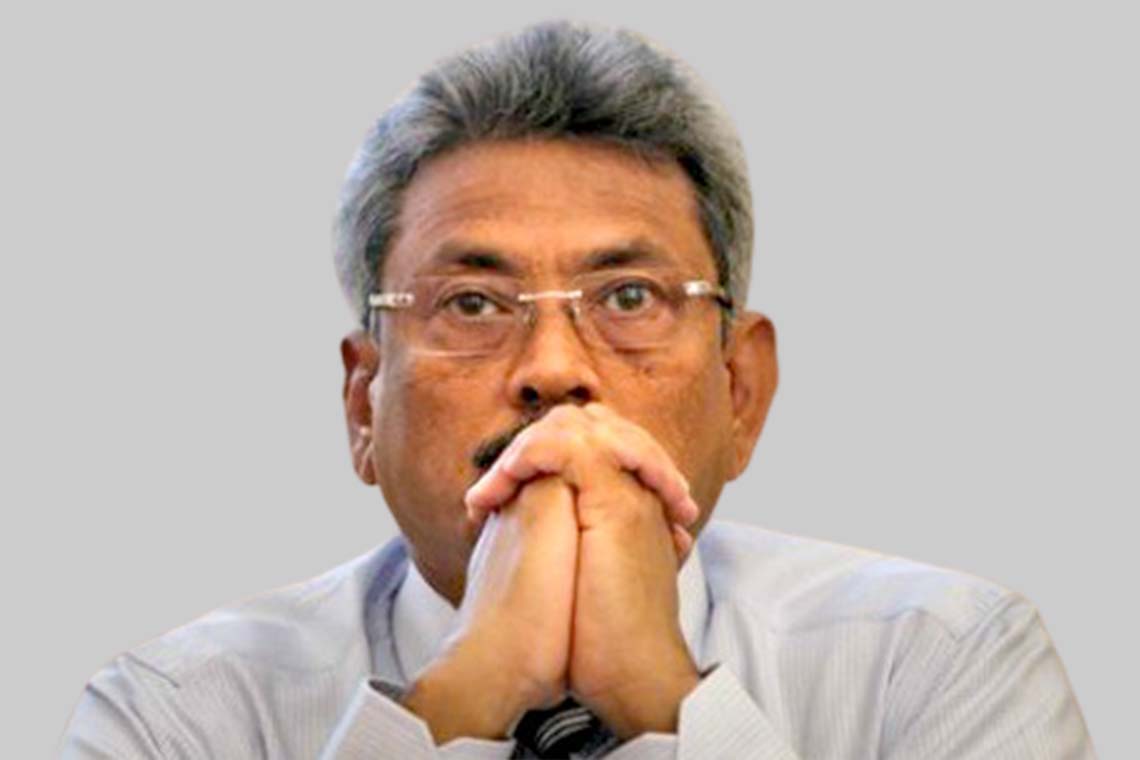

The Attorney General on Monday (06) requested the Court of Appeal to refer to the Supreme Court the writ petition filed by former President Gotabaya Rajapaksa, seeking an order to prevent his arrest in connection with the investigations into the Easter Sunday terrorist attacks.
The petition was taken up for the third consecutive day before a bench comprising Court of Appeal President Justice Rohantha Abeysuriya and Justice Sanath Dissanayake.

Attorney General’s Submissions
Deputy Solicitor General Suharshi Herath, appearing for the respondents, told the court that although the petitioner had claimed he did not know Azad Maulana, there was evidence indicating that the two had met.
She informed the court that, according to a statement recorded by the Criminal Investigation Department (CID) from Iniya Bharathi, who is currently in custody, Hendavitharana had contacted him in 2019 and requested that he meet Gotabaya Rajapaksa.
The Deputy Solicitor General marked before court Bharathi’s statement, which stated that when he visited Gotabaya Rajapaksa’s residence in Mirihana, he saw Azad Maulana, the secretary and treasurer of Pillayan’s political party, along with several other individuals staying there.
The respondents also submitted photographs showing Azad Maulana with Gotabaya Rajapaksa. Responding to a question raised by the President of the Court of Appeal, the Deputy Solicitor General confirmed that the photographs had been taken at Gotabaya Rajapaksa’s residence in Mirihana.
Deputy Solicitor General Herath further argued that the petitioner was alleging violations of his personal liberty and freedom of movement, which are matters relating to fundamental rights.
“These issues fall within the scope of Article 126 of the Constitution. Therefore, only the Supreme Court has jurisdiction to determine such matters,” she submitted.
Petitioner’s Submissions
President’s Counsel Romesh de Silva, appearing for Gotabaya Rajapaksa, argued that the petition had been filed to prevent his client from being subjected to an arbitrary arrest that would unlawfully interfere with his personal liberty.
He submitted that Supreme Court precedents clearly establish that an arrest must be supported by strong evidence and reasonable suspicion before a person’s liberty can be restricted.
President’s Counsel de Silva further argued that none of the commissions appointed to investigate the Easter Sunday attacks had implicated Gotabaya Rajapaksa. He pointed out that even the report of the Commission of Inquiry headed by former Supreme Court Justice S.I. Imam, appointed following the allegations made by Britain’s Channel 4, contained no findings against the former President.
Responding to the photographs submitted by the respondents, de Silva argued that politicians are frequently photographed with numerous individuals. He noted that the petitioner had also been photographed with political leaders, including Douglas Devananda, R. Sampanthan, and Prabha Ganesan, and that Azad Maulana’s appearance in a photograph on various occasions could not, by itself, establish any criminal connection.
He further submitted that it was surprising that the Attorney General was supporting the respondents’ position, particularly in light of a recent Supreme Court judgment delivered by Chief Justice Surasena, which reaffirmed the principles against arbitrary arrest.
After considering the submissions made by both parties, the Court of Appeal adjourned further hearing of the petition until July 9, when the Deputy Solicitor General is expected to continue her submissions.
Court of Appeal Postpones Hearing of Gotabaya’s Petition Until June 24
Join our WhatsApp / Telegram groups below.