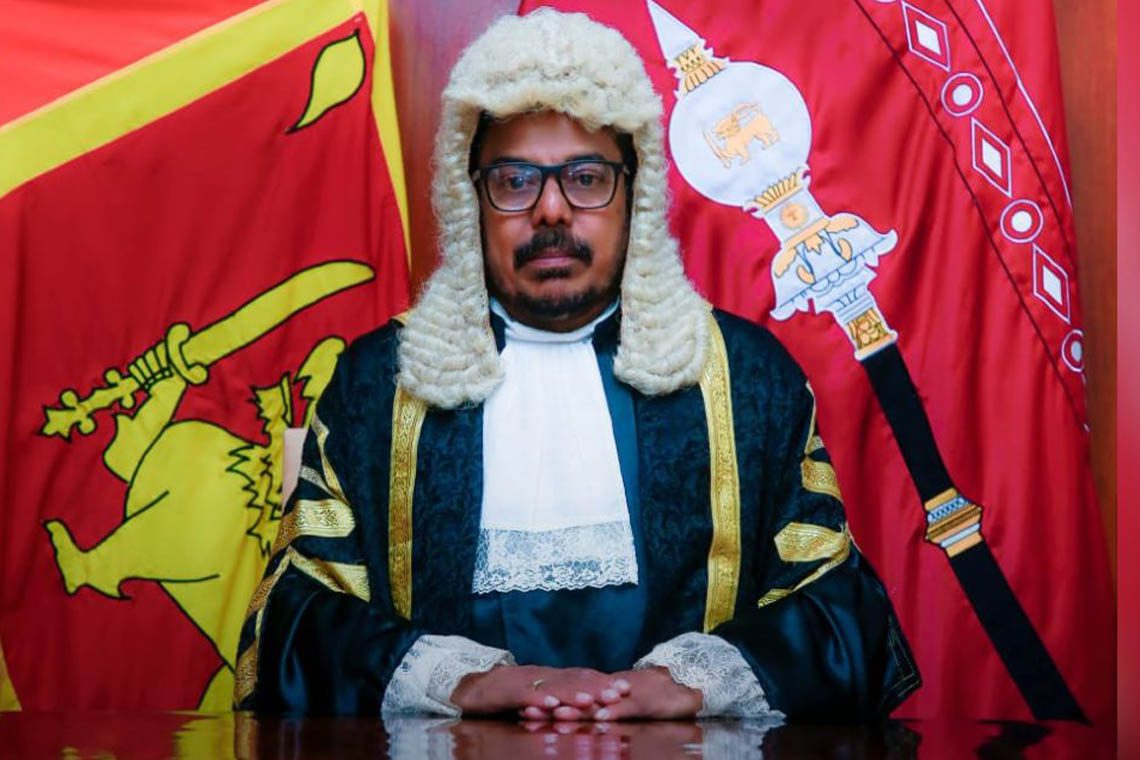

Nearly a year after resigning as Speaker over his failure to substantiate the doctoral title he publicly used, Parliamentarian Ashoka Ranwala has once again become the focus of national attention this time following a serious road traffic accident and the troubling manner in which the incident was handled by law enforcement.
In a statement issued on 13 December 2024 upon stepping down as Speaker, Ranwala assured the public that he would soon submit documentary proof relating to a doctoral degree allegedly awarded by a research institute affiliated with Waseda University in Japan. That assurance, however, remains unfulfilled. Despite the passage of time, no such documents have been produced, leaving unresolved doubts about his academic claims and personal credibility.
Ranwala himself admits to the hospital
Against this backdrop, Ranwala resurfaced earlier this month as a suspect in a traffic accident that occurred on the night of 11 December in the Sapugaskanda area. The vehicle in which he was travelling first collided with a motorcycle and then crashed into a motor car approaching from the opposite direction. As a result, two womena mother and a daughter who were travelling in the car, along with a seven-month-old infant, sustained injuries and were hospitalized. Ranwala himself was also admitted for treatment.
While initial Police statements described the injuries as minor, later information revealed that the two women had suffered serious injuries and required surgery. The infant was admitted to the Lady Ridgeway Hospital for Children. These discrepancies between official statements and actual medical facts became one of the main reasons for growing public distrust.
Public debate intensified not only over Ranwala’s conduct, but also over the actions or inaction of the Police. There was a noticeable delay in arresting the MP, and Police communication was marked by contradictions and vague wording. Different Police officials provided conflicting accounts of whether an arrest had taken place and which unit was responsible. The absence of clear and timely information fuelled suspicions of preferential treatment.
Ranwala under the influence of Aalcohol?
Matters worsened when videos circulated on social media alleging that Ranwala had been intoxicated at the time of the accident. Despite the seriousness of this allegation, the Police appeared slow to address it. The Police later admitted that breathalyser kits were unavailable at the Sapugaskanda Police Station, raising further questions as to why alternative arrangements were not made in a timely manner. A medical test was reportedly conducted at the hospital, but its results were not immediately disclosed.
Only last evening did the Police state that investigations had confirmed MP Ranwala was not under the influence of alcohol at the time of the accident. While this clarification addressed one aspect of public concern, it did little to erase doubts about the broader handling of the case.
Did Police bend the Law?
Following mounting criticism, it has now been confirmed that several Police officers, including the Officer-in-Charge of the Sapugaskanda Police Station, neglected their duties in relation to the incident. The Inspector General of Police has stated that disciplinary action will be taken and that the public will be informed in due course.
Political reactions further complicated the situation. While a small number of government MPs attempted to defend Ranwala, a social media post by Minister K.D. Lalkantha describing him as a “good man” sparked widespread backlash, even among those sympathetic to the ruling coalition. The remark reignited debate over whether personal character should excuse questionable conduct by public representatives.
Taken together, these events have once again placed Ashoka Ranwala at the centre of a wider discussion on accountability, transparency, and equal application of the law. For a government elected on promises of clean governance and institutional reform, the episode has become a test of credibility. A year after his dramatic resignation as Speaker, Ranwala’s name continues to be associated not with reform, but with unresolved questions and a deepening erosion of public trust.
By Senuka, Australia