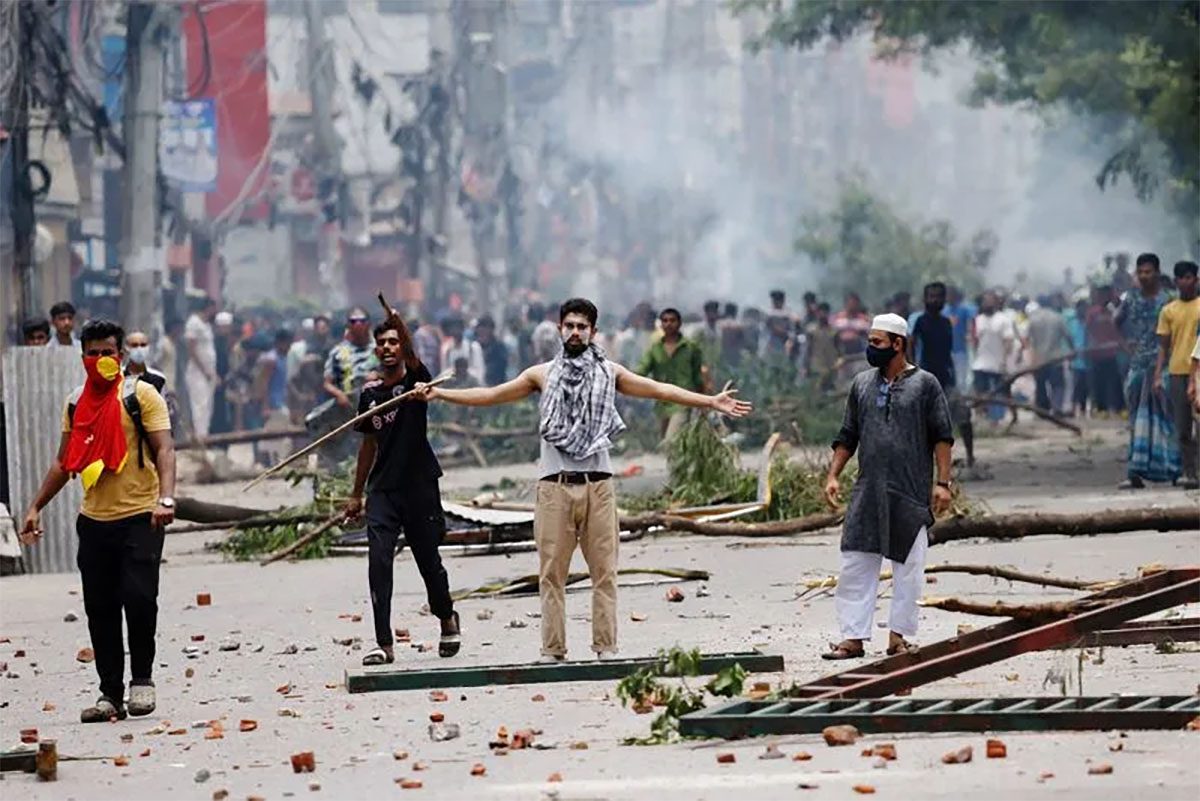

Following the widening student-led protests against the government job quotas, Sheikh Hasina’s government in Bangladesh have imposed a nationwide curfew and deployed an army. Amid the government’s crackdown on the protest and content use of the lethal force, more than 105 individuals died.
According to local reports, more than 1500 individuals injured by the force used by the government’s law enforcement to control the protest.

Meanwhile, telecommunication were also disrupted and television news channels also went off the air. Bangladesh authorities had cut some mobile telephone services the previous day in an attempt to try to quell the unrest.
Following the protest, train services in Bangladesh had been suspended across the country as some protesters have blocked roads. According to local reports, protesters have threw bricks at security officials amid the clash between two sides.
Meanwhile, United Nations Human Rights Chief Volker Türk called on for accountability and dialogue in Bangladesh. Issuing a statement, Türk sated that he is deeply concerned by this week’s violence in Bangladesh, resulting in reports of dozens of deaths and hundreds of injuries. The attacks on student protesters are particularly shocking and unacceptable.
He also called for an impartial, prompt and exhaustive investigation into the attacks, and suggested that those responsible be held to account.
United Nations Human Rights Chief also urged all sides to exercise restraint and call on the security forces to ensure that any use of force is strictly in line with the requirements of international human rights law.
Some analysts attribute the recent violence to broader economic challenges, including high inflation and dwindling foreign exchange reserves. The protests have reignited old and sensitive political tensions between those who fought for Bangladesh’s independence from Pakistan in 1971 and those accused of collaborating with Islamabad. The Awami League party, led by Hasina, has labeled the protesters as “razakar,” a term used for independence-era collaborators.
International rights groups have criticized the suspension of services and the actions of security forces. The European Union expressed deep concern over the violence and loss of life, stating, “It is vital that further violence is averted and that a peaceful resolution to the situation is found as swiftly as possible, underpinned by the rule of law and democratic freedoms.”
Neighboring India commented that the unrest was an internal matter for Bangladesh and assured that all 15,000 Indians in the country were safe. Indian students in Bangladesh were reported to be returning home by road.
Violence related to the protests also erupted in London, home to a significant Bangladeshi community, where police intervened to stop clashes between large groups of men in the city’s east.
Join our WhatsApp / Telegram groups below.