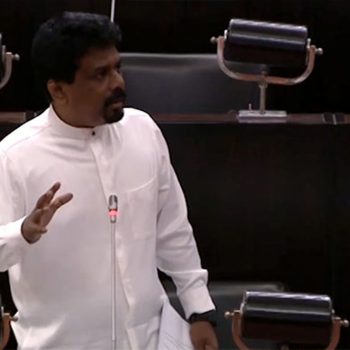

In a blistering parliamentary address yesterday, President Anura Kumara Dissanayake lifted the lid on what may be one of the most audacious financial heists in Sri Lanka’s history: nearly $1 billion siphoned overseas through fake import payments since 2023, roughly one-third of the $3 billion IMF Extended Fund Facility (EFF) approved to rescue the country’s collapsed economy.
Speaking during the adjournment debate on the drug menace, the President painted a damning picture of a deeply entrenched “nexus of corruption, organised crime, and political patronage” that has hollowed out the nation’s institutions.
“Since 2023, advance payments amounting to nearly $1 billion have been made through Telegraphic Transfer (TT) transfers, yet no goods have been received,” Dissanayake declared. “Ordinary individuals cannot move such sums.”
The Scale of the Betrayal
To put the figure in perspective:
Sri Lanka secured a $3 billion IMF bailout to stabilise its economy after the devastating 2022 financial crisis.
Investigations now reveal that $1 billion, one-third of that lifeline, appears to have been spirited out of the country through bogus “advance payment” schemes for phantom imports.
Earlier this month, Public Security Minister Ananda Wijepala had already flagged $85 million in suspicious transactions. The President revealed that deeper probes uncovered a far larger operation involving certain bank branches, drug trafficking proceeds, corruption loot, and organised criminal networks.
These were not isolated mistakes. According to the President, the illicit flows are symptoms of a “deeply embedded ecosystem” that has infiltrated state institutions, political structures, and even sections of law enforcement, the same rot that contributed to the country’s economic meltdown.
Not Revenge – Justice
Dissanayake was careful to frame the ongoing crackdown as the fulfilment of a democratic mandate rather than political score-settling.
“If our intention had been revenge, it would have been carried out the moment we assumed office,” he said. The government’s goal, he insisted, is to strengthen anti-corruption laws, expand investigative powers, and fast-track court processes so that “those who stole public property are brought to justice.”
A Nation Robbed Twice
For ordinary Sri Lankans, the revelation is salt in the wound.
The 2022 crisis brought fuel shortages, power blackouts, soaring inflation, and widespread hardship. Families sacrificed, queued for hours, and endured immense pain while the country sought international help. Now it emerges that as the IMF money was meant to rebuild reserves and restore stability, hundreds of millions were allegedly being wired abroad for goods that never arrived, possibly funding luxury lifestyles, drug empires, and political protection rackets.
The President’s message was clear: the fight against drugs, corruption, and organised crime is not a separate battle. They are the same. The same networks that trafficked narcotics and protected criminals also engineered the financial sabotage of the nation.
As investigations continue and more names potentially surface, Sri Lankans are left asking a painful question: How much of the pain they endured over the past years was not just bad governance, but outright theft on an industrial scale?
The $1 billion that vanished represents far more than numbers on a ledger. It represents stolen futures, lost opportunities, and a devastating betrayal of a people who were told their sacrifices would help rebuild the country.
The government has pledged to dismantle these networks. For a nation still reeling from economic collapse, the success of that promise may determine whether Sri Lanka finally breaks free from the cycle of corruption or remains trapped by it.
IMF Unlocks $695 Million Boost for Sri Lanka With Two Tranches