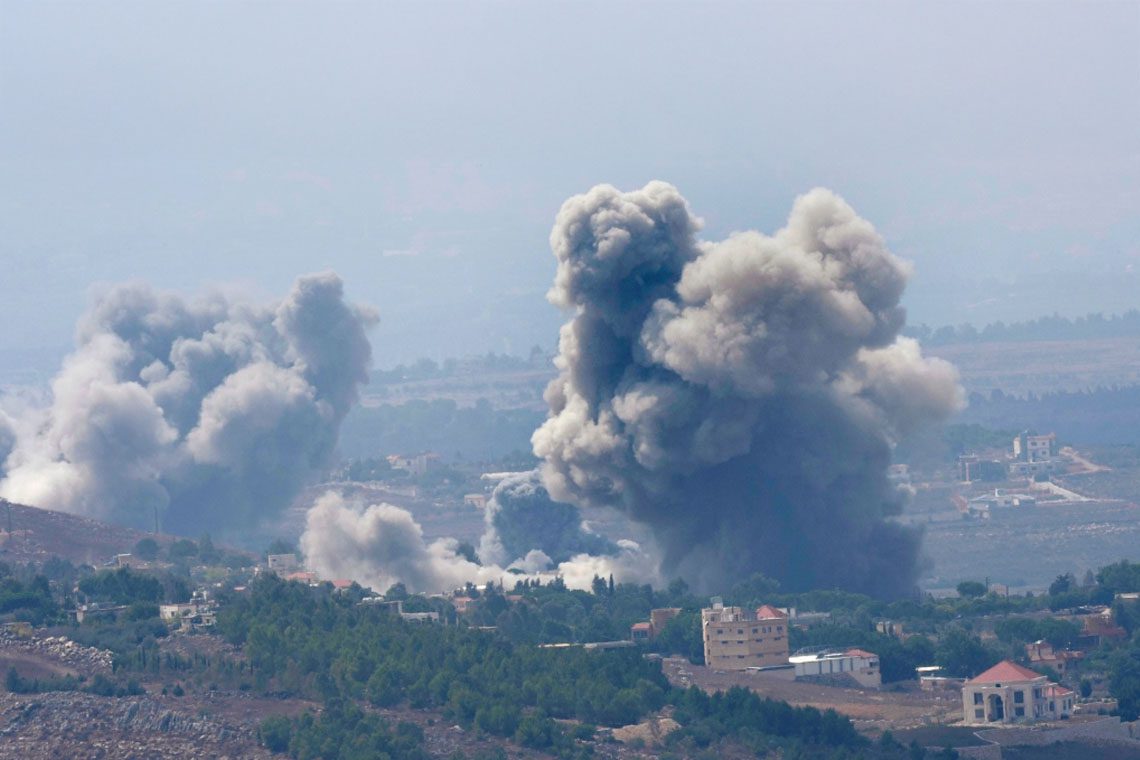

An Israeli airstrike in Lebanon has killed 492 people and wounded over 1,500, as tens of thousands flee for safety. Following some of the most intense cross-border exchanges of fire since the outbreak of hostilities in October, Israel warned civilians in Lebanon to evacuate areas where Hezbollah is allegedly storing weapons.
In New York, Iranian politician Masoud Pezeshkian, attending the UN General Assembly, accused Israel of provoking Iran into joining the conflict in support of Hezbollah. When asked whether Iran would defend the Lebanese group, Pezeshkian stated that Tehran would “defend any group that is defending its rights and itself,” but emphasized that Iran seeks peace.
“We do not wish to be the cause of instability in the Middle East, as the consequences would be irreversible,” said Pezeshkian, who was elected in July on promises of a pragmatic foreign policy. “We don’t want war. It is Israel that seeks to create this all-out conflict.”
Israeli Prime Minister Benjamin Netanyahu addressed the Lebanese people in a brief video message, stating, “Israel’s war is not with you, it’s with Hezbollah. For too long, Hezbollah has been using you as human shields.”
Families in southern Lebanon scrambled to escape, loading cars, vans, and trucks with their belongings. Multiple generations packed into vehicles, children sitting on their parents’ laps as bombs fell and suitcases were strapped to car roofs.
Hezbollah retaliated by launching over 200 rockets into northern Israel, according to the Israeli military. Paramedics reported that two people were injured by shrapnel.
UN Secretary-General António Guterres voiced concern over the escalating violence, stating he did not want Lebanon to “become another Gaza.” EU foreign affairs chief Josep Borrell called the situation “extremely dangerous and worrying” ahead of a UN gathering in New York, warning that “we are almost in a full-fledged war.”
Meanwhile, U.S. President Joe Biden said that Washington was working to de-escalate the conflict “in a way that allows people to return home safely.” The Pentagon also announced it was sending “a small number” of additional troops to the Middle East as a precautionary measure.