
President Donald Trump signalled a return to aggressive trade policies on Monday, threatening higher tariffs on two major U.S. trading partners while extending a crucial negotiation deadline.
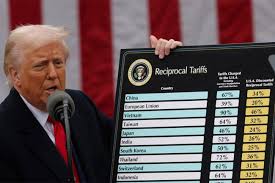
Around midday, Trump released letters addressed to Japan and South Korea, warning of 25% tariffs, and potentially higher duties on products suspected of being rerouted through these countries. Transshipping involves transferring goods between different transport modes, and the proposed 25% tariff mirrors the levels Trump announced in his surprise “Liberation Day” speech on April 2.
Later that day, Trump issued similar letters proposing tariffs of up to 40% on imports from Laos and Myanmar, 30% on goods from South Africa, and 25% on products from Malaysia and Kazakhstan. He plans to enforce these tariffs using powers under the International Emergency Economic Powers Act, though his authority to do so is currently under court review.
The stock market reacted negatively to these developments, with the S&P 500 dropping by as much as 1% after the letters were posted on Trump’s Truth Social account. Markets had already opened lower due to conflicting messages from the White House about the significance of Wednesday’s deadline set by Trump in April for imposing these sweeping tariffs.
Later on Monday, White House Press Secretary Karoline Leavitt announced that Trump would extend the Wednesday deadline to August 1 through an executive order. This continues the uncertainty that has marked U.S. trade policy since Trump’s April 2 speech, which triggered a historic market downturn when he initially announced extreme import duties on multiple countries. Although he paused the immediate implementation, markets only recently recovered to record highs.
Despite the deadline extension, Trump maintained a firm stance. When asked last Friday about potential flexibility for certain countries, he replied, “Not really. They’ll start to pay on Aug. 1. The money will start to come into the United States on Aug. 1, OK, in pretty much all cases.”
Treasury Secretary Scott Bessent later attempted to clarify, stating that reciprocal tariff rates would not resume until August 1, while also mentioning that the president was prioritising the “quality” of trade deals over their number, without elaborating further.
White House spokesman Kush Desai summed up the situation by stating that all trade decisions would ultimately come directly from President Trump, indicating that ongoing negotiations remain unpredictable.
So far, Trump has announced only a few new trade arrangements, including limited deals with the UK and China, and a short statement about an agreement with Vietnam. On Sunday, he posted on social media that “UNITED STATES TARIFF Letters, and/or Deals, with various Countries from around the World, will be delivered starting at noon Monday.
Additionally, Trump warned late Sunday of an extra 10% tariff on countries aligning with BRICS policies — the bloc comprising Brazil, Russia, India, China, and South Africa — in response to their leaders’ meeting in Rio de Janeiro. The specific justification for this move was not detailed.
Analysts at Capital Economics said the tariff uncertainty is unlikely to derail the U.S. economy entirely, but warned it could complicate the Federal Reserve’s policy decisions. The Fed has resisted Trump’s repeated calls for interest rate cuts, keeping rates high amid concerns that new import taxes could fuel inflation, raising borrowing costs for both consumers and the government.
They concluded, “Many at the Federal Reserve are hesitant to cut rates until the inflationary impact of tariffs is clearer, and we do not expect cuts this year.”