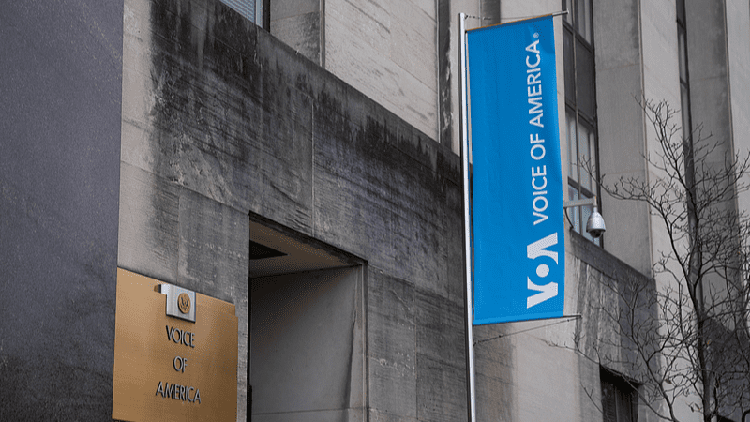

In a move that has sparked intense debate, US President Donald Trump has signed an executive order to shut down Voice of America (VOA), the country’s oldest and largest international media organization. Established in 1942 during World War II, VOA has long been regarded as a pillar of US public diplomacy, providing news and information to global audiences. However, the president’s decision to dismantle the network has drawn sharp criticism, with media experts and international organizations warning of severe consequences for press freedom and global information dissemination.
A Historic Institution in American Media
Voice of America was originally created as part of the US effort to counter Nazi and Japanese propaganda during World War II. Using transmission equipment leased from the BBC, the organization provided reliable news to audiences in war-torn regions. Over the decades, it expanded significantly, growing into a global broadcasting powerhouse that currently delivers news in 48 languages through radio, television, and digital platforms. VOA’s daily reach exceeds 361 million people worldwide, making it a significant force in international media.
In 1976, then-President Gerald Ford signed an executive order to make VOA a state-controlled media entity. Since then, it has operated under the US Agency for Global Media (USAGM) and has been funded by the federal government, with an annual budget exceeding $267 million.
Trump’s Justification and Political Context
President Trump’s decision to shut down VOA is rooted in his longstanding criticism of the network. He has accused it of pursuing an anti-Trump agenda, claiming that it no longer serves its intended purpose of promoting US interests abroad. The closure order follows growing tensions between Trump’s administration and various media organizations, with the president frequently accusing news outlets of spreading misinformation and being biased against him.
Elon Musk, a prominent entrepreneur and presidential advisor, had recently called for the dismantling of VOA through his X (formerly Twitter) account. His statements reinforced the administration’s stance that VOA was not aligned with the government’s vision and should be shut down to prevent further ideological conflicts.
With the executive order now in place, approximately 1,300 employees of VOA have been placed on unpaid leave, leading to further backlash from media unions and journalism advocates.
Media Experts’ Concerns and Warnings
The decision to dismantle VOA has been met with strong opposition from media experts and international organizations. Many argue that the closure of America’s oldest international broadcaster represents a significant step toward media repression.
“Voice of America has played an essential role in providing independent journalism to millions of people worldwide. Shutting it down eliminates a vital source of reliable information, especially in countries where press freedom is under threat,” said Jane Lippman, a senior analyst at the International Press Institute.
Others believe that dismantling VOA sets a dangerous precedent for government intervention in the media. Robert Carmichael, a former VOA journalist, expressed concerns over the broader implications of the executive order. “This move signals to authoritarian regimes worldwide that it is acceptable to suppress independent media under the guise of political differences. It weakens America’s credibility as a defender of free speech.”
Implications for Global Press Freedom
The closure of VOA could have far-reaching consequences beyond the United States. Many of VOA’s listeners reside in countries where independent journalism is restricted or heavily censored. From regions in Africa to parts of Asia and the Middle East, VOA has been a trusted source of uncensored news. Its broadcasts have provided critical reporting on issues such as human rights violations, political corruption, and social justice movements.
With VOA dismantled, media experts fear that audiences in these regions will be left with fewer alternatives for reliable news. “In places like Iran, North Korea, and China, where state-controlled media dominates, VOA has been a rare source of truthful reporting,” noted David Weinstein, a professor of media studies. “Its closure will leave millions more vulnerable to government propaganda.”
Political and Legal Challenges
Trump’s executive order has already faced legal challenges, with lawmakers and press freedom advocates pushing back against the decision. Some members of Congress have called for an immediate reversal, arguing that shutting down VOA violates the principles of the First Amendment, which protects freedom of the press.
Senator Lisa McAllister, a Democrat from California, has vowed to introduce legislation that would restore VOA’s operations. “This is an unacceptable attack on the free press. Voice of America has been a beacon of truth for decades, and we cannot allow political motives to silence it.”
Meanwhile, lawsuits are expected to be filed by media unions and employees affected by the shutdown. Legal experts suggest that the case could reach the Supreme Court if no resolution is found through legislative means.
The Future of International Broadcasting
With VOA now dismantled, questions remain about the future of US-funded international broadcasting. The US Agency for Global Media oversees several other networks, including Radio Free Europe/Radio Liberty and Radio Free Asia, which could face similar threats under the current administration’s policies.
Many are concerned that the loss of VOA is just the beginning of a broader effort to reshape America’s media landscape. “We may be witnessing the beginning of a new era where governments feel emboldened to control and restrict media operations at will,” warned Angela Robertson, a senior researcher at the Committee to Protect Journalists.
Conclusion
The closure of Voice of America by President Trump’s executive order marks a significant turning point in the history of international media. While the administration argues that VOA had become politically biased, critics see the move as a dangerous suppression of press freedom. Media experts warn that the decision could have far-reaching consequences, from emboldening authoritarian regimes to weakening America’s role in global journalism.
As legal and political battles unfold, the fate of VOA and its legacy remains uncertain. What is clear, however, is that the decision to shut down one of the most influential international broadcasters in history will have lasting implications for the media landscape both in the United States and around the world.
Lankasara Media Team