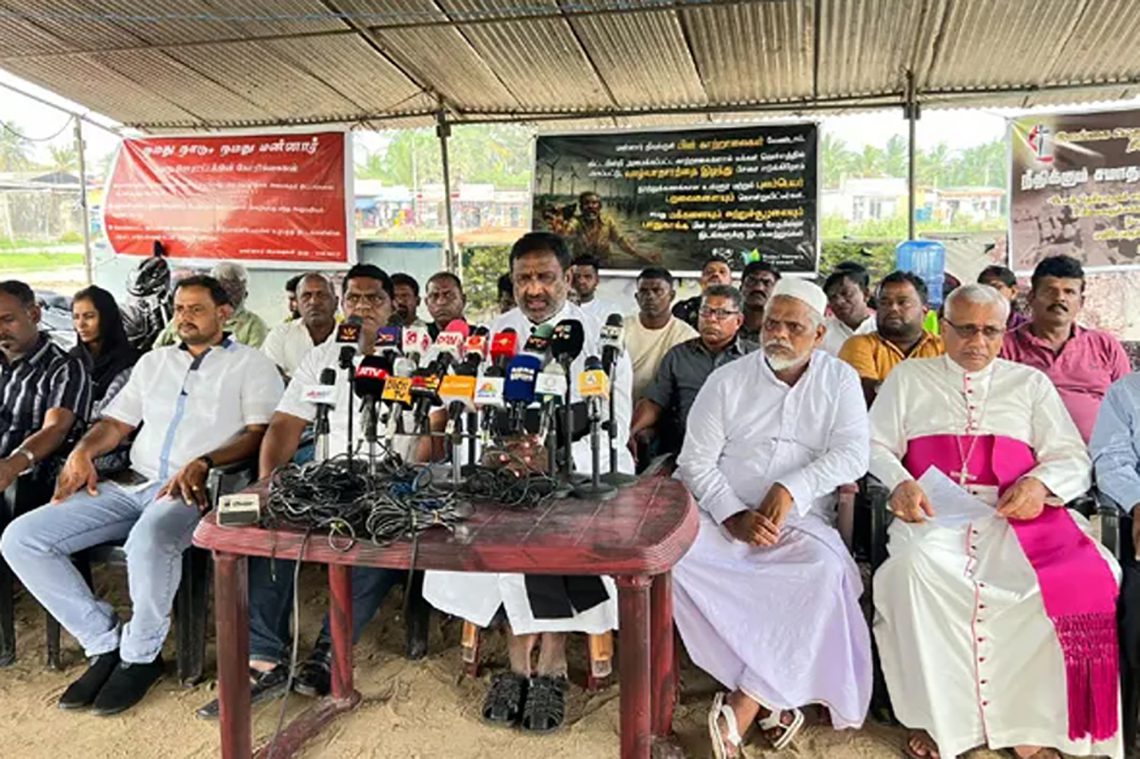

After more than three months of non-stop demonstrations, Mannar’s longest-running environmental protest came to an abrupt halt yesterday(15), bringing to a pause a 105-day community-led campaign that challenged the Government’s approval of major wind farm construction and mineral sand mining on the island.
The protest, which drew together a coalition of voluntary organisations and residents from across the district, had become a defining show of public resistance against what many saw as high-risk development projects imposed without sufficient consultation or environmental scrutiny.

Announcing the suspension of the continuous agitation, Mannar Citizens’ Committee Chairman Father Marcus Adigalar said the decision was taken in good faith, with demonstrators now awaiting a clear, official response from the Government to the concerns they had raised throughout the campaign. He stressed, however, that the halt should not be seen as a withdrawal, warning that residents stand ready to resume their protest should the authorities fail to provide satisfactory assurances.
The movement began on the night of 27 September, when residents mobilised swiftly to block the unloading of turbines and related equipment destined for a wind power project on Mannar Island. The sudden intervention triggered a tense standoff, with police attempting to clear the route and protesters forming human barriers to prevent the machinery from entering the area. The confrontation set the tone for what would become a prolonged, highly visible challenge to the project.
Over the following weeks, the protest site grew into a focal point of community sentiment, with participants highlighting fears over environmental degradation, threats to fishing livelihoods, and the long-term implications of mineral sand extraction in the fragile coastal belt. Activists argued that the island’s ecological sensitivity demanded a more transparent and participatory approach to development planning.
By calling off the protest after 105 days, organisers say they have placed responsibility squarely on the Government to respond decisively. Mannar’s residents now await whether their unprecedented mobilisation will prompt meaningful engagement—or whether the district will once again be forced into the streets to protect its land and livelihoods
Join our WhatsApp / Telegram groups below.