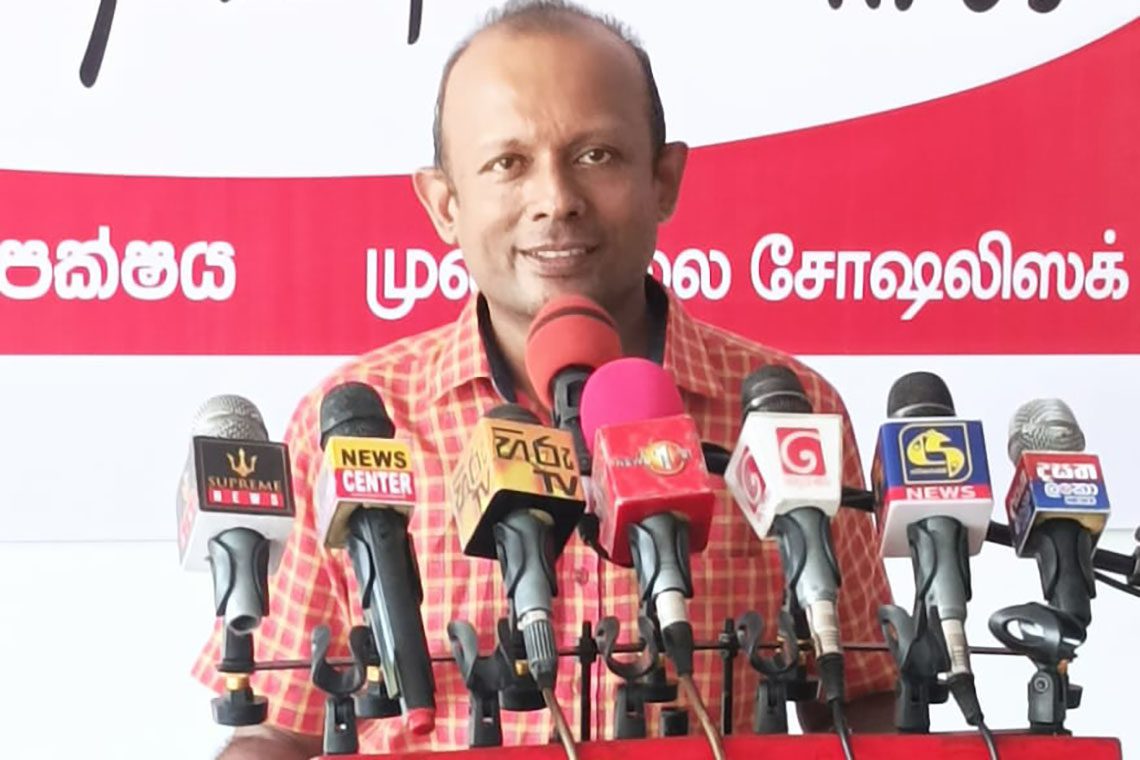

Pubudu Jayagoda, Education Secretary of the Socialist Front Party, has accused the government of manipulating procurement rules to award Sri Lanka’s coal supply tender to a discredited company, Trident Chemphar. He claimed that procurement criteria were deliberately altered in violation of guidelines, allowing the company to qualify despite its long record of corruption.
Jayagoda emphasized that corruption in Sri Lanka has never been confined to politicians alone. Instead, it operates through a powerful alliance of politicians, high-ranking government officials, and businessmen. Although anti-corruption campaigns have focused almost exclusively on politicians, he argued that this network now functions effectively even without their direct involvement.
Speaking at a seminar in Polonnaruwa today (28), Jayagoda detailed how the coal tender was awarded:
“On September 15, the tender for coal supply for power generation was awarded to Trident Chemphar, the lowest bidder. But this result is highly questionable. According to the 2021 Sri Lanka Coal Registration Document, only companies with reserves of at least one million metric tons of coal with a GCV of 5900 kCal/kg could register. By 2025, however, the qualification requirement had been reduced to just 100,000 metric tons. This 90 percent reduction was no accident. It appears to have been designed to benefit this company.”
He further highlighted Trident Chemphar’s controversial past. The Auditor General’s report submitted to the Public Enterprises Committee on 20 September 2016 records that the company violated procurement guidelines when supplying 30,000 metric tons of rice to Sathosa in 2014. One of its owners, Sarath Chandra Reddy, was arrested in New Delhi in 2022 on charges of money laundering linked to an excise duty scam. Its Sri Lankan representative, Sarath Bandara Jayasundara, a former cricket analyst, was banned from international cricket for seven years in 2019 following match-fixing charges.
“Despite this history, the government has still chosen to entrust the country’s coal supply to Trident Chemphar. Both the owner and the representative carry corruption charges, yet procurement rules have been changed in their favor. This is clear evidence of systemic fraud,” Jagoda asserted.
He also accused the government of hypocrisy in its approach to energy policy:
“When electricity board employees protested against privatization moves, the President rushed to declare electricity an essential service. Yet when the coal tender, usually opened in March, was delayed until July, the essential nature of electricity was conveniently forgotten. When the minimum reserve requirement for coal suppliers was reduced by 90 percent, that too was overlooked. When policies were introduced to discourage rooftop solar power, another essential contribution to the grid, it was ignored once again. And when tariffs were raised to unbearable levels for ordinary people, the government still failed to acknowledge electricity as essential to human life.”
Jagoda concluded that the coal tender scandal exposes the true priorities of the government: “This single scam is enough to ask the fundamental question—whose interests is this government serving? Certainly not the people’s.”