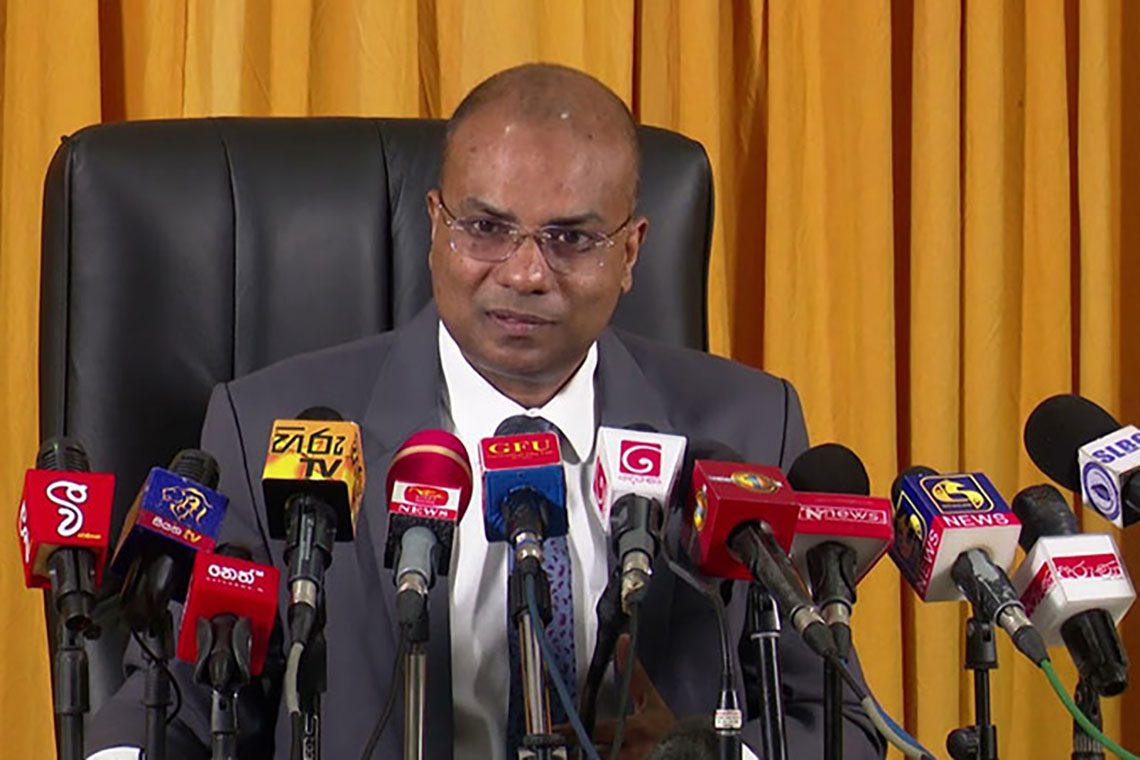

Director General of the Commission to Investigate Allegations of Bribery or Corruption (CIABOC), Ranga Dissanayake, today (02) categorically rejected the claim made by former Janatha Vimukthi Peramuna (JVP) MP Nandana Gunathilaka that he had been involved in active politics with the JVP, describing the allegation as “completely false.” He said this appears to be part of an organized campaign aimed at sabotaging both his work and the role of CIABOC. Dissanayake explained that the smear campaign first surfaced with accusations that he had acted illegally to secure his child’s admission to a Colombo high school. However, following an investigation conducted without his consent, it was confirmed that the allegation was unfounded. He further announced that legal action would be taken against those responsible for spreading such falsehoods.
Dissanayake stated that if Gunathilaka truly believes he is unfit to serve as a judge, the matter should be referred to the Judicial Service Commission, and if he believes he is unfit to serve as Director General of CIABOC, it should be referred to the Constitutional Council rather than resorting to media conferences. He emphasized that CIABOC has decided to treat such remarks not as personal attacks but as direct insults against the Commission itself, and that proceedings will be pursued under Section 118 of the CIABOC Act.
Speaking at a media briefing today, Dissanayake underscored that these issues must be explained to the people of the country rather than to politicians. “I believe the people of this country have placed their trust in me and in CIABOC at this time,” he said, adding that one of the objectives behind the campaign is to deliberately undermine that trust. He further noted that the allegations are being made in an organized manner with the clear intention of diverting the Commission from its fundamental mission.
Addressing the school admission issue in detail, Dissanayake said that upon receiving the complaint, he made three requests: that an independent investigation be carried out without his involvement; that he be informed if wrongdoing was found; and that the findings be made public if he was cleared of any misconduct. He added that after the relevant documents were collected and an investigation completed, CIABOC issued a press release as requested. He noted that an order has also been issued to proceed with further steps, and stressed that if the complaint proves false, the complainant will face action under the Anti-Corruption Act and Section 125-2 of the CIABOC Act for making a false statement.
Responding to the claim of political involvement, Dissanayake outlined his judicial career, stating that he became a magistrate in 2004, was appointed a High Court judge in 2020, and commenced his second term in 2025. He argued that if he had indeed been engaged in active politics, he would have been ineligible to serve as a judge. He questioned why Gunathilaka had not raised this issue before the Judicial Service Commission over the past two decades if he genuinely believed it to be true.
Finally, Dissanayake categorically denied any association with committees of the type Gunathilaka referred to, insisting that such claims are entirely baseless. He stressed that the burden of proof rests with the accuser and warned that unless Gunathilaka produces evidence, legal action will be taken against him for insulting CIABOC.